
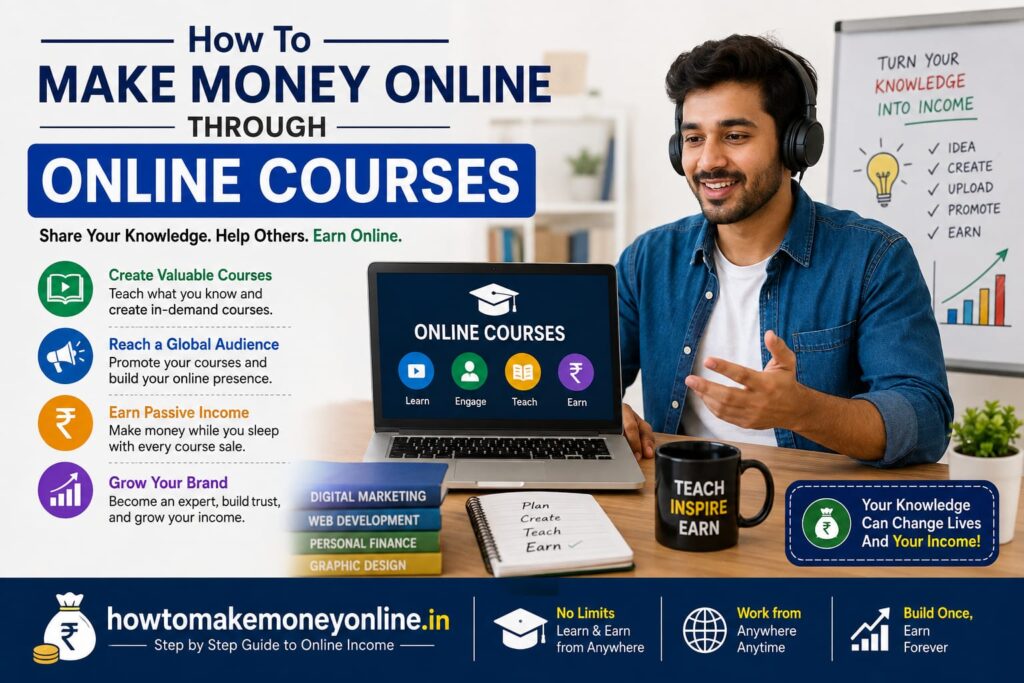
How to Make Money Online Through Selling Online Courses: A Complete Beginner’s Guide
Selling online courses is one of the most promising ways to turn your knowledge, skills, experience, or expertise into an online income stream. Instead of exchanging your time for money through one-to-one work, you can create a course once and potentially sell access to it to many students.
You don’t need to be a famous teacher or have a large company to get started. If you have useful knowledge that can help someone learn a skill, solve a problem, improve their career, save time, or achieve a specific result, you may be able to turn that knowledge into an online course.
However, creating a course is only half the business. Successful course creators also need to understand audience research, course creation, pricing, marketing, sales, student support, and continuous improvement.
This guide explains how to make money by selling online courses, what you can teach, how to create your first course, which platforms you can use, different ways to earn, essential skills, marketing strategies, and common mistakes beginners should avoid.
What Is an Online Course?

An online course is a structured educational program delivered through the internet.
It may contain:
- Video lessons
- Audio lessons
- Written lessons
- Presentations
- PDFs and workbooks
- Quizzes
- Assignments
- Projects
- Downloadable resources
- Live classes
- Student communities
- Certificates
For example, a person who knows graphic design could create:
“Graphic Design for Beginners: Learn Canva from Scratch”
A teacher could create:
“Complete Mathematics Course for Class X Students”
A professional could create:
“How to Start a Small Business in India”
A blogger could create:
“Complete WordPress Blogging Course for Beginners”
The possibilities are enormous.
How Does Selling an Online Course Work?
The basic business model is simple:
Knowledge → Course Creation → Marketing → Student Enrollment → Payment → Learning Experience
For example:
- You know how to create websites.
- You identify beginners who want to learn website development.
- You create a structured course.
- You upload it to an online-course platform.
- You promote the course through your website, YouTube, social media, email, or other channels.
- Students purchase the course.
- You provide the learning materials and support.
- You receive revenue according to your pricing and platform/payment arrangements.
Some platforms provide course-building, payment, student-management, and marketing tools. For example, Teachable currently provides tools for creating and selling courses, managing students, and building sales experiences.
Why Are Online Courses a Good Way to Make Money?
- Turn Knowledge Into a Product
Your knowledge can become a digital product that can be sold repeatedly.
Instead of teaching the same basic lesson separately to 100 people, you can create a structured course that students can access whenever they enroll.
- Global Audience
An online course is not restricted to students in your city.
Depending on the subject and language, you may be able to reach students across India or internationally.
- Flexible Business Model
Students can often learn at their own convenience, particularly with self-paced courses.
- Multiple Revenue Opportunities
A course can become the foundation for additional products and services such as:
- Advanced courses
- Coaching
- Consulting
- Memberships
- Workshops
- Ebooks
- Templates
- Paid communities
- Build Your Personal Brand
A high-quality course can establish you as an expert in your chosen field.
- Potential for Recurring or Scalable Revenue
A well-designed course can continue generating sales after its initial creation, although it will still require marketing, maintenance, updates, and customer support.
What Can You Teach in an Online Course?
You don’t necessarily need to teach an academic subject.
People buy courses to learn practical skills and achieve specific outcomes.
Here are some ideas.
Education
- Mathematics
- Science
- English
- Computer education
- Exam preparation
- Study skills
Technology
- Python
- Web development
- WordPress
- Excel
- Data analysis
- Artificial intelligence
- Cybersecurity fundamentals
Creative Skills
- Graphic design
- Photography
- Video editing
- Canva
- Drawing
- Music
- Writing
Business
- Entrepreneurship
- Digital marketing
- E-commerce
- Blogging
- Freelancing
- Social media marketing
Professional Skills
- Communication
- Public speaking
- Presentation design
- Leadership
- Project management
- Resume writing
Personal Development
- Productivity
- Time management
- Goal setting
- Study techniques
Language Learning
- English
- Hindi
- Bengali
- Assamese
- Other languages
The best course topic is usually not simply something you know. It should be something people actually want to learn and are willing to invest in.
How to Choose a Profitable Course Topic
Choosing the right topic is one of the most important decisions you’ll make.
Ask yourself these questions:
- What Do I Know Well?
Make a list of your:
- Skills
- Professional experience
- Hobbies
- Qualifications
- Areas of expertise
- Problems you’ve solved
- What Problems Do People Have?
For example, instead of creating:
“Everything About Photography”
consider:
“Smartphone Photography for Beginners”
The second topic is more specific and easier for a potential student to understand.
- Are People Searching for This Knowledge?
Research:
- Google searches
- YouTube searches
- Online communities
- Social-media discussions
- Existing courses
- Student questions
- Competitor websites
- Will Students Get a Clear Result?
A strong course should promise a realistic learning outcome.
For example:
“Learn to Create Your First WordPress Website in 30 Days”
is more specific than:
“Learn WordPress.”
Think about the transformation your course can provide.
Step-by-Step: How to Create Your First Online Course
Step 1: Choose a Specific Target Audience
Don’t try to teach everyone.
Instead, identify a specific group.
For example:
- Class X students
- College students
- Beginners
- Small business owners
- Freelancers
- Teachers
- Homemakers
- Job seekers
- New bloggers
A specific audience makes it easier to design your course and marketing message.
Step 2: Define the Course Outcome
Before recording anything, complete this sentence:
“After completing this course, students will be able to ______.”
For example:
“After completing this course, students will be able to create and manage their own WordPress website.”
This becomes the foundation of your curriculum.
Step 3: Create a Course Outline
Divide your course into modules and lessons.
For example:
Course: WordPress for Beginners
Module 1: Introduction to WordPress
Module 2: Domain and Hosting
Module 3: Installing WordPress
Module 4: Choosing a Theme
Module 5: Creating Pages
Module 6: Creating Blog Posts
Module 7: Plugins
Module 8: SEO Basics
Module 9: Website Security
Module 10: Launching Your Website
Each module can contain several short lessons.
A structured curriculum makes the course easier to follow.
Step 4: Decide Your Course Format
You don’t necessarily need to make everything video-based.
You can use:
- Video
- Screen recordings
- Slides
- PDFs
- Audio
- Quizzes
- Assignments
- Downloadable templates
- Live sessions
For technical subjects, screen recordings can be extremely useful.
For language courses, a combination of video, audio, exercises, and downloadable material can work well.
Step 5: Create Your Course Content
Write your lesson plans before recording.
For each lesson, determine:
- What will students learn?
- What examples will you provide?
- What should students do?
- What common mistakes should they avoid?
- What should they know before moving to the next lesson?
Avoid unnecessary information.
A course isn’t better simply because it contains 20 hours of video.
Useful and focused content is more important than course length.
Step 6: Record Your Lessons
You don’t need a professional studio to begin.
A basic setup can include:
- Smartphone or camera
- Microphone
- Tripod
- Good lighting
- Quiet room
- Screen-recording software
For many beginner courses, clear audio is more important than having an expensive camera.
Speak clearly and avoid unnecessary background noise.
Step 7: Edit Your Videos
Basic editing can make your course much more professional.
You can:
- Remove mistakes
- Remove long pauses
- Add titles
- Add captions
- Highlight important information
- Add screen demonstrations
- Improve audio
- Divide long lessons into smaller sections
Keep lessons focused and reasonably easy to consume.
Step 8: Create Supporting Materials
Give students resources that help them apply what they learn.
Examples include:
- PDF notes
- Checklists
- Worksheets
- Templates
- Exercises
- Project files
- Cheat sheets
- Reading lists
For example, a digital-marketing course could include a content-planning template.
These resources can increase the practical value of your course.
Step 9: Choose an Online Course Platform
There are several ways to sell an online course.
- Udemy
Udemy is a large online learning marketplace where instructors can create courses and reach students through the platform.
Udemy currently states that instructors can create an instructor account without an account-opening fee, while paid courses operate under its revenue-share model. It also has course requirements, including a minimum amount of video content and lectures/modules for published courses.
Good for: Beginners who want access to an established course marketplace.
- Teachable
Teachable allows creators to build and sell online courses and other learning products. Its current platform includes course creation, student engagement, sales, and payment-related tools.
Good for: Creators who want more control over their own course business and branding.
- Thinkific
Thinkific provides tools for building and selling courses, including support for video, text, images, downloads, audio, presentations, assignments, surveys, quizzes, and analytics.
Good for: Course creators who want a dedicated online learning platform.
- Graphy
Graphy is another platform aimed at creators and educators. Its current offering includes courses, webinars, memberships, digital products, communities, and tools for building an online teaching business.
Good for: Creators, educators, coaches, and businesses looking for an all-in-one course platform, particularly those targeting the Indian market.
Which Platform Should a Beginner Choose?
There isn’t one universally best platform.
Consider:
- Platform fees
- Revenue sharing
- Payment options
- Marketing tools
- Branding
- Student-management features
- Analytics
- Course ownership
- Your target audience
- Whether you want a marketplace or your own branded course business
Always check the current pricing, fees, policies, and payment availability before making a decision because platform terms can change.
Step 10: Set the Right Course Price
Pricing can be difficult for beginners.
Don’t choose a price randomly.
Consider:
- Course depth
- Your expertise
- Student outcome
- Course quality
- Competition
- Target audience
- Support included
- Bonuses and resources
- Your brand reputation
You can experiment with different pricing models.
Low-Cost Course
A short introductory course designed to attract beginners.
Standard Course
A comprehensive course with lessons, exercises, and resources.
Premium Course
A detailed program that may include:
- Personal feedback
- Live sessions
- Community access
- Assignments
- Mentoring
Don’t assume that the cheapest course will always sell the most.
People often pay more for a course when the outcome and value are clear.
How to Make Money From Online Courses
Selling the course itself is the primary revenue model, but there are several other ways to build income around your educational content.
- Sell Individual Courses
The simplest model is:
Student Pays → Student Gets Course Access
- Course Bundles
Combine several related courses into one package.
For example:
Digital Marketing Bundle
- SEO
- Social Media Marketing
- Email Marketing
- Content Marketing
A bundle can provide greater value than selling each course individually.
- Memberships
You can offer students ongoing access to:
- New lessons
- Monthly workshops
- Resources
- Community
- Q&A sessions
This can create recurring revenue where the business model and platform support it.
- Live Workshops
Use your recorded course as the foundation and offer paid live workshops.
For example:
“4-Week YouTube Growth Workshop”
- Coaching and Consulting
Students who complete your course may want personalized help.
You can offer:
- One-to-one coaching
- Group coaching
- Business consulting
- Career guidance
- Portfolio reviews
- Sell Digital Products
You can sell related:
- Ebooks
- Templates
- Worksheets
- Checklists
- Spreadsheets
- Design assets
- Study materials
- Corporate Training
Businesses may pay for employee training.
For example:
- Excel training
- Communication training
- Digital marketing
- Leadership
- Software training
This can become a higher-value business model.
How to Market Your Online Course
Creating an excellent course doesn’t guarantee sales.
People need to discover it first.
- Build a Blog
Create free articles around your course topic.
For example, if you sell a WordPress course, publish articles such as:
- How to Start a WordPress Website
- Best WordPress Themes
- How to Install WordPress Plugins
- How to Improve WordPress Security
Then naturally introduce your course where it provides additional value.
- Use YouTube
YouTube can be an excellent way to demonstrate your expertise.
If your course teaches video editing, publish free tutorials such as:
“How to Edit Your First YouTube Video”
At the end, you can explain that your complete course provides a more structured learning path.
- Social Media
Share useful educational content through:
- X
- Other relevant platforms
Don’t make every post a sales advertisement.
A useful strategy is:
Educate → Build Trust → Demonstrate Expertise → Offer Course
- Email Marketing
Build an email list by offering a useful free resource.
For example:
Free PDF: 25 Essential WordPress Tips for Beginners
After someone subscribes, you can send useful educational emails and occasionally introduce your paid course.
- Free Mini-Course
A short free course can introduce potential students to your teaching style.
If they find the free content valuable, they may be more interested in your complete program.
- Webinars
Host a free or paid webinar related to your course topic.
For example:
“How to Start Freelancing in 2026: A Beginner’s Workshop”
At the end, introduce your complete freelancing course.
The Power of a Free-to-Paid Course Strategy
One effective approach is:
Free Content → Audience → Trust → Low-Cost Product → Main Course → Premium Services
For example:
Free
YouTube tutorials ↓
Free
Blog articles ↓
Free
PDF guide ↓
Low-Cost
Mini-course ↓
Main Product
Complete course ↓
Premium
Coaching or consulting
This creates a complete educational business rather than depending on one product.
Skills You Need to Sell Online Courses
You don’t need to master every skill before starting.
However, these skills can help.
- Subject Expertise
You need genuine knowledge of what you’re teaching.
- Teaching Ability
Knowing something and teaching it effectively are two different skills.
Learn to explain complex ideas simply.
- Content Creation
You need to create lessons, presentations, worksheets, and other materials.
- Video Production
Basic recording and editing skills are useful for video courses.
- Marketing
You need to know how to attract potential students.
- Copywriting
Your course landing page should explain:
- Who the course is for
- What students will learn
- What problems it solves
- What is included
- Why the course is valuable
- SEO
SEO can help people discover your free educational content through search engines.
- Email Marketing
Email can help you build a direct relationship with your audience.
- Customer Support
Students may need help with:
- Access
- Lessons
- Assignments
- Payments
- Technical issues
Professional support can improve the student experience.
Common Mistakes Beginners Should Avoid
- Creating a Course Nobody Wants
This is one of the biggest mistakes.
Don’t spend months creating a course before checking whether there is genuine demand.
Research the market first.
- Making the Course Too Broad
Avoid trying to teach everything.
Instead of:
“Complete Business Course”
consider:
“How to Start an Online Business for Beginners”
Specific topics are easier to understand and market.
- Making Lessons Too Long
A 60-minute lesson isn’t necessarily better than six 10-minute lessons.
Break complicated topics into manageable sections.
- Focusing Too Much on Production Quality
You don’t need a Hollywood production studio.
Students generally care more about:
- Clear explanations
- Useful content
- Good audio
- Practical examples
- Easy navigation
- Copying Other Courses
Never copy another instructor’s:
- Videos
- Slides
- Scripts
- PDFs
- Images
- Exercises
Create original educational material or use properly licensed resources.
- Using AI to Create Everything
AI can help with brainstorming, outlines, examples, editing, and other tasks, but don’t let it replace your expertise.
Students are paying for your knowledge, teaching, experience, examples, and guidance.
Review and fact-check anything generated with AI.
- Setting an Unrealistic Price
A very high price without demonstrating sufficient value can discourage buyers.
At the same time, constantly underpricing your course can make it difficult to build a sustainable business.
- Ignoring Marketing
An excellent course with no audience may generate very few sales.
Start marketing before the course launch rather than waiting until the course is finished.
- Never Updating Your Course
Technology and information change.
For subjects such as:
- AI
- SEO
- Digital marketing
- Software
- Programming
- E-commerce
outdated lessons can quickly reduce the value of your course.
Review your content regularly.
- Promising Guaranteed Results
Avoid claims such as:
“Complete this course and earn ₹1 lakh every month.”
Students’ results depend on many factors.
Instead, clearly explain what the course teaches and what students can reasonably expect to learn.
How to Get Your First Students
If you have no audience, getting your first students can feel difficult.
Try this approach:
Step 1
Teach the topic for free through short videos and articles.
Step 2
Create a free downloadable resource.
Step 3
Build an email list or social-media audience.
Step 4
Launch a small introductory course.
Step 5
Ask early students for genuine feedback.
Step 6
Improve the course based on feedback.
Step 7
Create testimonials where permitted and with appropriate student consent.
Step 8
Launch the improved course to a larger audience.
Your first goal should not necessarily be thousands of students.
Your first goal can be:
10 satisfied students.
Then:
50 students.
Then:
100 students.
Build gradually.
Online Course Business for Indian Creators
India has a large and diverse audience interested in online learning.
Creators can develop courses in:
- English
- Hindi
- Bengali
- Assamese
- Other Indian languages
Regional-language courses can be particularly useful where high-quality learning resources are limited.
A 30-Day Plan to Create Your First Online Course
Week 1: Research
- Choose a topic.
- Identify your target audience.
- Research competitors.
- Study students’ problems.
- Validate demand.
- Define the course outcome.
Week 2: Course Development
- Create your curriculum.
- Write lesson outlines.
- Prepare presentations.
- Create worksheets.
- Prepare examples and exercises.
Week 3: Production
- Record lessons.
- Edit videos.
- Create PDFs.
- Prepare quizzes.
- Upload content.
Week 4: Launch
- Create your sales page.
- Set your price.
- Announce the course.
- Publish promotional content.
- Contact your existing audience.
- Collect feedback.
- Improve the course.
Don’t worry about making your first course perfect.
Make it useful, clear, practical, and honest.