
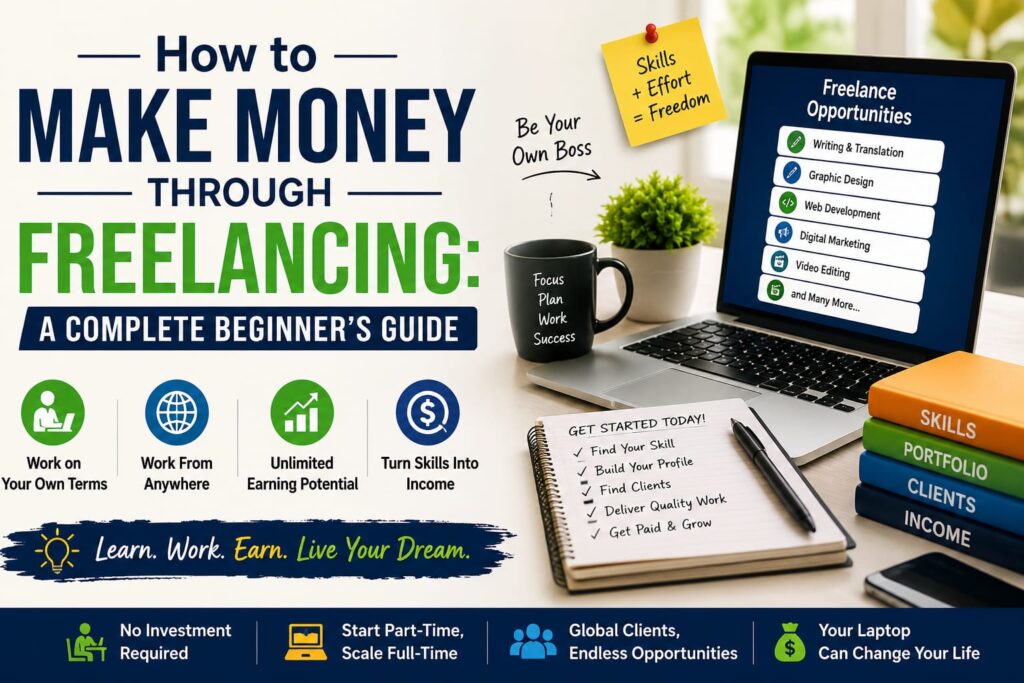
How to Make Money Through Freelancing: A Complete Beginner’s Guide
Freelancing is one of the most accessible ways to make money online. Instead of working permanently for one company, freelancers offer their skills and services to different clients and get paid for completing individual projects or ongoing assignments.
Today, businesses, startups, entrepreneurs, content creators, and individuals around the world hire freelancers for everything from writing and graphic design to programming, video editing, digital marketing, translation, and virtual assistance.
The best part is that you can start freelancing from home with a computer or smartphone, an internet connection, and a marketable skill.
What Is Freelancing?
Freelancing means working independently for clients rather than being employed permanently by a single organization.
For example, imagine that a company needs a professional article for its website. Instead of hiring a full-time writer, it may hire a freelance writer to create the article for a fixed fee.
Similarly:
- A YouTuber may hire a freelance video editor.
- A startup may hire a freelance website developer.
- An online store may hire a graphic designer.
- A company may hire a translator for its documents.
- A business owner may hire a freelancer to manage social media.
- A student may hire a freelancer to design a presentation.
The freelancer completes the agreed work and receives payment.

Why Is Freelancing a Good Online Income Opportunity?
Freelancing has become popular because it offers flexibility and allows people to sell their skills to clients beyond their local area.
1. Work From Almost Anywhere
You can generally work from home, a co-working space, or another suitable location as long as you have the required equipment and internet connection.
2. Choose Your Skills
You don’t necessarily need a university degree to begin freelancing. A useful skill, a strong portfolio, reliability, and the ability to communicate professionally can be more important for many freelance jobs.
3. Work With International Clients
Freelancing platforms and professional networks allow skilled workers to find clients from different countries.
4. Flexible Working Hours
Many freelance projects allow you to decide when you work, provided that you meet the client’s deadline.
5. Multiple Income Sources
A freelancer can work with several clients instead of depending on a single employer.
6. Low Startup Cost
Unlike many traditional businesses, freelancing can often be started without renting an office or purchasing inventory.
Top Freelancing Skills You Can Sell Online
There are hundreds of freelance services available online. Here are some of the most popular categories.
1. Content Writing
If you have strong writing skills, you can offer:
- Blog articles
- Website content
- Product descriptions
- Newsletters
- Social-media captions
- Business articles
- Technical writing
- SEO content
- Scripts for YouTube videos
A good writer should focus on grammar, research, originality, readability, and delivering work according to the client’s requirements.
2. Graphic Design
Graphic designers can create:
- Logos
- Business cards
- Social-media graphics
- YouTube thumbnails
- Posters
- Brochures
- Advertisements
- Presentations
- Infographics
- Website graphics
You can begin with tools such as Canva and gradually learn professional design software as your skills improve.
3. Video Editing
The growth of YouTube, Instagram Reels, Shorts, online courses, and digital advertising has created demand for video editors.
Freelancers can offer:
- YouTube video editing
- Short-form video editing
- Reels and Shorts
- Promotional videos
- Educational videos
- Podcast editing
- Subtitles and captions
- Basic animation
- Video advertisements
4. Web Development
If you know programming or website-building tools, you can offer:
- WordPress websites
- Business websites
- Landing pages
- E-commerce websites
- Website maintenance
- Website speed optimization
- Custom web applications
Web development can become a particularly valuable freelance skill as your experience grows.
5. Programming
Programmers can work on:
- Websites
- Mobile applications
- Software
- APIs
- Automation
- Database systems
- Bug fixing
- Custom tools
Popular programming skills include Python, JavaScript, Java, PHP, C#, and other technologies.
6. Translation
If you are fluent in two or more languages, translation can become a useful freelance service.
Services can include:
- Document translation
- Website translation
- Subtitle translation
- Product descriptions
- Educational material
- Business communication
- Localization
Accuracy is extremely important. Machine translation should not simply be copied and delivered as professional human translation.
7. Digital Marketing
Businesses need people who can help them reach customers online.
Freelance digital marketing services can include:
- SEO
- Social-media marketing
- Email marketing
- Content marketing
- Search advertising
- Social-media advertising
- Competitor research
- Marketing strategy
8. Virtual Assistant Services
A virtual assistant helps businesses or individuals with online administrative tasks.
Examples include:
- Email management
- Data entry
- Online research
- Scheduling
- Spreadsheet management
- Customer support
- File organization
- Basic social-media management
9. Voice-Over Services
If you have a clear and engaging voice, you can offer voice-over services for:
- YouTube videos
- Advertisements
- Educational content
- Audiobooks
- Explainer videos
- Podcasts
- Corporate presentations
10. Presentation Design
Many professionals and students need attractive presentations.
You can create:
- Business presentations
- Educational presentations
- Sales presentations
- Pitch decks
- Training materials
- Infographics
How to Start Freelancing Step by Step
Step 1: Choose One Marketable Skill
The biggest mistake beginners make is trying to offer everything.
Instead, choose one primary skill.
For example:
“I will create professional YouTube thumbnails.”
is more specific than:
“I provide all types of digital services.”
A specific service makes it easier for potential clients to understand what you offer.
Step 2: Learn the Skill
You don’t need to become an expert before starting, but you should be capable of delivering professional-quality work.
Learn through:
- Free online tutorials
- Courses
- Practice projects
- Books
- Documentation
- Real-world projects
Spend time practicing rather than only watching tutorials.
Step 3: Create Sample Work
Before you have clients, create your own sample projects.
For example, if you want to become a graphic designer, create:
- 3 sample logos
- 5 social-media posts
- 2 posters
- 3 YouTube thumbnails
These examples become your portfolio.
Step 4: Build a Professional Portfolio
A portfolio demonstrates what you can actually do.
Your portfolio should contain your best work rather than every project you’ve ever created.
For each project, explain:
Project: YouTube Thumbnail Design
Objective: Create a high-click visual for an educational video
Work: Concept, layout, typography and final design
A professional portfolio can significantly improve your chances of attracting clients.
Step 5: Create Your Freelancing Profile
There are several websites and professional networks where freelancers can find clients.
Examples include:
You can also find clients through LinkedIn, your own website, professional communities, and direct outreach.
Step 6: Write a Professional Profile
Your profile should quickly answer three questions:
What do you do?
Who do you help?
Why should a client hire you?
For example:
“I am a professional content writer specializing in SEO-friendly blog articles for small businesses and online publishers. I create well-researched, original and reader-friendly content designed to provide genuine value to audiences.”
Avoid making unrealistic claims such as “I am the world’s best writer.”
Step 7: Start With Realistic Pricing
Beginners often struggle with pricing.
Don’t automatically charge extremely low prices just because you’re new.
Instead, consider:
- Your skill level
- Project complexity
- Time required
- Client requirements
- Market rates
- Revision requirements
- Your experience
You can start competitively and increase your rates as your portfolio, reputation, and expertise grow.
Step 8: Apply for Suitable Projects
Don’t send the same generic proposal to every client.
Read the project description carefully and explain how you can solve the client’s specific problem.
A strong proposal should be:
- Short
- Relevant
- Professional
- Personalized
- Focused on the client’s needs
Instead of writing:
“Sir/Madam, I am interested in your project. Please give me this opportunity.”
Write something more specific:
“I noticed that you need short-form videos edited for your educational channel. I can create clean, engaging videos with captions, transitions and platform-appropriate formatting. I have attached relevant samples of my previous work.”
Step 9: Communicate Professionally
Good communication is one of the most important freelancing skills.
Always:
- Respond politely.
- Ask necessary questions.
- Confirm requirements.
- Agree on deadlines.
- Keep the client updated.
- Communicate problems early.
- Avoid unnecessary arguments.
- Deliver what you promised.
Step 10: Meet Your Deadlines
A freelancer’s reputation is built not only on skill but also on reliability.
If you agree to deliver something on Friday, try to deliver it before or by Friday.
Repeatedly missing deadlines can damage your reputation and reduce future opportunities.
How Much Can a Freelancer Earn?
There is no fixed freelancing salary.
Income can vary significantly depending on:
- Skill
- Experience
- Portfolio quality
- Type of service
- Number of clients
- Client location
- Pricing
- Reputation
- Demand for the skill
- Ability to find repeat customers
A beginner may initially earn little while building a portfolio. An experienced freelancer with specialized skills and a strong client base can potentially earn much more.
Therefore, beginners should focus first on building valuable skills and a reliable reputation rather than chasing a specific income figure.
How to Get Your First Freelancing Client
Getting the first client is often the hardest part.
Here are some practical approaches.
Approach 1: Freelancing Platforms
Create a professional profile and apply for projects that match your skills.
Approach 2: Direct Outreach
Find businesses that could benefit from your service and contact them professionally.
For example, if you are a graphic designer, you could approach small businesses whose social-media graphics could be improved.
Approach 3: LinkedIn
Build a professional profile and share useful content related to your skill.
Approach 4: Personal Network
Tell people you know about your services. Your first client may come through a friend, colleague, business owner, or professional connection.
Approach 5: Build Your Own Website
A personal website can showcase:
- About you
- Services
- Portfolio
- Testimonials
- Contact information
- Pricing or starting packages
It also helps establish your professional identity.
How to Increase Your Freelancing Income
Once you have some experience, don’t simply try to work more hours.
Instead, try to increase the value you provide.
Specialize
Instead of being a general writer, become a:
“B2B technology content writer”
Instead of being a general designer, become a:
“YouTube thumbnail designer for educational channels”
Specialization can help you stand out.
Improve Your Skills
Keep learning new tools and techniques related to your field.
Increase Your Rates Gradually
As your skills and portfolio improve, review your pricing.
Find Repeat Clients
A repeat client can be more valuable than constantly searching for new customers.
Offer Packages
Instead of selling individual tasks, you can create packages.
For example:
YouTube Starter Package
- 4 edited videos
- 8 thumbnails
- Basic captions
- Monthly support
Packages can make your service easier to understand and sell.
Build Long-Term Relationships
The goal shouldn’t always be to complete one project and disappear.
A satisfied client may need your services every month.
Common Freelancing Mistakes Beginners Should Avoid
1. Offering Too Many Services
Trying to be a writer, designer, programmer, marketer, editor and translator at the same time can make your profile look unfocused.
2. Copying Other People’s Portfolios
Never claim someone else’s work as your own.
3. Underpricing Everything
Very low prices may attract difficult clients and make it difficult to sustain your business.
4. Missing Deadlines
Reliability matters enormously.
5. Ignoring Client Requirements
Read the brief carefully before starting.
6. Accepting Impossible Projects
Don’t accept work that you cannot realistically complete.
7. Poor Communication
Even excellent work can lead to problems if communication is poor.
8. Depending on One Platform
Over time, consider developing multiple sources of clients, such as your own website, LinkedIn, referrals, and professional networks.
9. Falling for Scams
Be careful with clients who:
- Ask you to pay money to receive a job.
- Request sensitive personal information unnecessarily.
- Promise unusually high payments for very simple work.
- Ask you to perform suspicious financial transactions.
- Send suspicious links or files.
- Refuse to use reasonable payment arrangements.
Always verify the client and understand the platform’s payment and dispute policies.
Freelancing in India
India has a large pool of skilled professionals who can offer services to both domestic and international clients.
Indian freelancers can provide services such as:
- Content writing
- Software development
- Graphic design
- Video editing
- Digital marketing
- Translation
- Virtual assistance
- Online tutoring
- Data-related services
- Website development
English proficiency can be particularly useful when working with international clients, while knowledge of Indian languages can create opportunities in regional-language content and translation.
Remember to keep proper records of your freelance income and understand the applicable Indian tax, invoicing, and payment rules as your freelancing business grows.
Freelancing vs. Traditional Employment
Freelancing |
Work for multiple clients |
Flexible schedule |
Income can vary |
Find your own clients |
More independence |
Responsible for your own business expenses |
Can work remotely |
Traditional Employment |
Usually work for one employer |
Usually fixed working hours |
Usually fixed salary |
Employer provides work |
More structured environment |
Employer generally handles many workplace costs |
May be remote, hybrid, or office-based |
Is Freelancing Suitable for Students?
Yes, freelancing can be an option for students who have a useful skill and can balance work with their studies.
Students can start with relatively small projects such as:
- Graphic design
- Video editing
- Writing
- Translation
- Presentation design
- Basic website creation
- Social-media content
However, education should remain a priority. Students should also follow applicable age requirements and platform rules before creating accounts or accepting paid work.
A Simple 30-Day Freelancing Plan
If you’re starting from zero, you can follow this basic roadmap.
Week 1 — Choose Your Skill
Select one skill based on your interests and market demand.
Week 2 — Learn and Practice
Spend several hours each day learning and creating sample projects.
Week 3 — Build Your Portfolio
Create 5–10 strong samples and prepare your professional profile.
Week 4 — Find Clients
Start applying for suitable projects, contacting potential clients, networking, and improving your proposals.
Don’t become discouraged if you don’t get your first client immediately. Building a successful freelance career can take time.
Final Thoughts
Freelancing is not a shortcut to instant wealth. It is a skill-based online business model.
The basic formula is simple:
Learn a valuable skill → Build a portfolio → Find clients → Deliver quality work → Build trust → Get repeat clients → Increase your value and rates.
If you are willing to learn, practice consistently, communicate professionally, and provide genuine value to clients, freelancing can become a powerful way to generate online income.
For beginners, the most important first step isn’t finding the highest-paying freelance job.
- August 8, 2026
- 1:11 pm